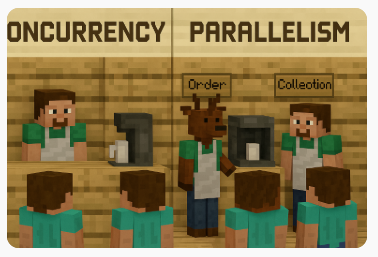
동시성처리와 병렬성처리는 유사해보이지만 큰 차이가있으며 간략하게 간략하게 설명될수 있습니다.
이 파일은 코루틴, 리액터(Reactor), CompletableFuture, Java Stream, Akka Streams, 액터(Actor) 등을 사용해서
"비동기 동시성" 그리고 "액터(Actor) 기반 메시지 통신" 테스트를 다양한 방법으로 검증하는 것입니다.
구체적으로는:
| 구분 | 내용 |
|---|---|
| 기초 비동기 처리 | Coroutine, Mono, CompletableFuture, Java Stream으로 "Hello World"를 만드는 간단한 동시성 테스트 |
| 병렬 실행 테스트 | 3개의 작업(문자열 생성+지연 메소드 호출 2개)을 병렬로 수행하여 하나의 문자열로 합치는 테스트 |
| Akka Stream 테스트 | Akka Streams를 사용하여 비동기 스트림 병합 테스트 |
| Actor Ask 패턴 테스트 | HelloActor를 대상으로 ask (질문→응답받기) 패턴 테스트 |
| Kotlin 기반 커스텀 KHelloActor 테스트 | 별도로 작성한 코루틴 기반 액터 (KHelloActor) 테스트 |
| 방법 | 요약 |
|---|---|
Coroutine | async로 비동기 작업하고 await()로 결과 가져옴 |
Mono | 리액터 기반 Mono 스트림 처리 |
CompletableFuture | 자바 기본 비동기 API 활용 |
Java Stream | 스트림 map 연산으로 변환 처리 후 CompletableFuture |
공통 목표: "Hello World" 문자열 생성 및 검증
    @Test
    fun testHelloByCoroutine() = runBlocking {
        // Test using CompletableFuture to concatenate strings asynchronously
        val input = "Hello"
        val result = withContext(Dispatchers.Default) {
            val part1 = async { input + " World" }
            part1.await()
        }
        assertEquals("Hello World", result)
} |
    @Test
    fun testHelloByMono() {
        // Test using Reactor Mono to concatenate strings asynchronously
        val input = "Hello"
        val monoResult = Mono.just(input)
            .map { it + " World" }
            .block()

        assertEquals("Hello World", monoResult)
} |
    @Test
    fun testHelloByCompletableFuture() {
        // Test using CompletableFuture to concatenate strings asynchronously
        val future = CompletableFuture.supplyAsync { "Hello" }
            .thenApplyAsync { result -> result + " World" }

        val result = future.get()

        assertEquals("Hello World", result)
} |
   @Test
    fun testHelloByJavaStream() {
        // Test using CompletableFuture with Java Streams to concatenate strings asynchronously
        val future = CompletableFuture.supplyAsync {
            listOf("Hello")
                .stream()
                .map { it + " World" }
                .findFirst()
                .orElse("")
        }
        val result = future.get()
        assertEquals("Hello World", result)
} |
getDelayString()와 getDelayString2()는 각각 600ms, 500ms 지연 후 "SlowWorld1", "SlowWorld2"를 반환합니다.
이걸 병렬로 돌려서:
Hello World SlowWorld1 SlowWorld2
라는 최종 문자열을 만들고 검증합니다.
방법별 특징:
Coroutineasync를 3개 띄워 await로 병합
MonozipWith으로 여러 Mono를 병렬 조합
FluxflatMap으로 병렬 작업 후 결과 모음
CompletableFuturethenCombineAsync로 결과 합성
Java Stream
Stream 내부에서 Future join()해서 결과 병합
Akka Stream
Source를 연결(zipWith)해서 결과를 스트림 합성
    @Test
    fun testConcurrentByCoroutine() = runBlocking {
        val input = "Hello"
        val result = withContext(Dispatchers.Default) {
            val part1 = async { input + " World" }
            val part2 = async { getDelayString() }
            val part3 = async { getDelayString2() }
            "${part1.await()} ${part2.await()} ${part3.await()}"
        }

        assertEquals("Hello World SlowWorld1 SlowWorld2", result)
} |
    @Test
    fun testConcurrentByMono() {
        val input = "Hello"
        val monoResult = Mono.just(input)
            .map { it + " World" }
            .zipWith(Mono.fromCallable { getDelayString() })
            .zipWith(Mono.fromCallable { getDelayString2() }) { part1, part2 ->
                "${part1.t1} ${part1.t2} $part2"
            }
            .block()

        assertEquals("Hello World SlowWorld1 SlowWorld2", monoResult)
} |
    @Test
    fun testConcurrentByFlux() {
        val input = listOf("Hello", "World")
        val fluxResult = Flux.fromIterable(input)
            .flatMap { data ->
                when (data) {
                    "Hello" -> Mono.fromCallable { getDelayString() }
                    "World" -> Mono.fromCallable { getDelayString2() }
                    else -> Mono.empty()
                }
            }
            .collectList()
            .map { results -> results.joinToString(" ") }
            .block()

        assertEquals("SlowWorld1 SlowWorld2", fluxResult)
} |
    @Test
    fun testConcurrentByCompletableFuture() {
        val future = CompletableFuture.supplyAsync { "Hello" }
            .thenApplyAsync { result -> result + " World" }
            .thenCombineAsync(CompletableFuture.supplyAsync { getDelayString() }) { part1, part2 ->
                "$part1 $part2"
            }
            .thenCombineAsync(CompletableFuture.supplyAsync { getDelayString2() }) { part1, part3 ->
                "$part1 $part3"
            }

        val result = future.get()

        assertEquals("Hello World SlowWorld1 SlowWorld2", result)
} |
    @Test
    fun testConcurrentByJavsStream() {
        val result = listOf("Hello")
            .stream()
            .map { input -> input + " World" }
            .map { part1 ->
                val part2 = CompletableFuture.supplyAsync { getDelayString() }.join()
                val part3 = CompletableFuture.supplyAsync { getDelayString2() }.join()
                "$part1 $part2 $part3"
            }
            .findFirst()
            .orElse("")

        assertEquals("Hello World SlowWorld1 SlowWorld2", result)
} |
    @Test
    fun testConcurrentByAkkaStream() {
        val materializer = Materializer.createMaterializer(actorSystem.system())

        val source = Source.single("Hello")
            .map { it + " World" }
            .zipWith(Source.single(getDelayString())) { part1, part2 -> Pair(part1, part2) }
            .zipWith(Source.single(getDelayString2())) { pair, part3 ->
                "${pair.first} ${pair.second} $part3"
            }
            .runWith(Sink.head(), materializer)

        val result = source.toCompletableFuture().get()

        assertEquals("Hello World SlowWorld1 SlowWorld2", result)
} |
HelloActor는 다음 특징을 갖습니다HelloActor:
"Hello" 메시지를 받으면 "Kotlin" 응답을 보낸다.
HelloCommand와 HelloResponse를 주고받음
여기서 검증하는 것:
Ask Pattern을 통한 응답 받기
다양한 방식 (Coroutine, WebFlux(Mono), CompletableFuture, Java Stream, Akka Stream)으로 액터에게 ask 보내고 응답받음
결국 모두 "Kotlin" 이라는 응답 메시지를 받아야 성공
Pekko의
AskPattern.ask메소드를 활용하고,Duration타임아웃 설정도 적용함
    @Test
    fun testActorAskByCoroutine() = runBlocking {
        // Test using Actor Ask pattern with coroutines
        val actorRef = actorSystem.spawn(HelloActor.create())
        var response = AskPattern.ask(
            actorRef,
            { replyTo: ActorRef<HelloCommand> -> Hello("Hello", replyTo) },
            Duration.ofSeconds(3),
            actorSystem.scheduler()
        ).toCompletableFuture().await()

        assertEquals(HelloResponse("Kotlin"), response)
} |
    @Test
    fun testActorAskByWebflux() {
        val actorRef = actorSystem.spawn(HelloActor.create())
        val result = Mono.just("Hello")
            .flatMap { input ->
                Mono.fromFuture(
                    AskPattern.ask(
                        actorRef,
                        { replyTo: ActorRef<HelloCommand> -> Hello(input, replyTo) },
                        Duration.ofSeconds(3),
                        actorSystem.scheduler()
                    ).toCompletableFuture()
                )
            }
            .map { response -> (response as HelloResponse).message }
            .block()

        assertEquals("Kotlin", result)
} |
    @Test
    fun testActorAskByCompletableFuture() {
        val actorRef = actorSystem.spawn(HelloActor.create())
        val future = CompletableFuture.supplyAsync { "Hello" }
            .thenCompose { input ->
                AskPattern.ask(
                    actorRef,
                    { replyTo: ActorRef<HelloCommand> -> Hello(input, replyTo) },
                    Duration.ofSeconds(3),
                    actorSystem.scheduler()
                ).toCompletableFuture()
            }
            .thenApply { response -> (response as HelloResponse).message }

        val result = future.get()
        assertEquals("Kotlin", result)
} |
    @Test
    fun testActorAskByJavaStream() {
        val actorRef = actorSystem.spawn(HelloActor.create())

        val result = listOf("Hello")
            .stream()
            .map { input ->
                AskPattern.ask(
                    actorRef,
                    { replyTo: ActorRef<HelloCommand> -> Hello(input, replyTo) },
                    Duration.ofSeconds(3),
                    actorSystem.scheduler()
                ).toCompletableFuture().join()
            }
            .map { response -> (response as HelloResponse).message }
            .findFirst()
            .orElse("")

        assertEquals("Kotlin", result)
} |
    @Test
    fun testActorAskByAkkaStream() {
        val actorRef = actorSystem.spawn(HelloActor.create())
        val materializer = Materializer.createMaterializer(actorSystem.system())

        val source = Source.single("Hello")
            .mapAsync(1) { input ->
                AskPattern.ask(
                    actorRef,
                    { replyTo: ActorRef<HelloCommand> -> Hello(input, replyTo) },
                    Duration.ofSeconds(3),
                    actorSystem.scheduler()
                ).toCompletableFuture()
            }
            .map { response -> (response as HelloResponse).message }
            .runWith(Sink.head(), materializer)

        val result = source.toCompletableFuture().get()
        assertEquals("Kotlin", result)
} |
    @Test
    fun testActorAskByAkkaStreamWithCoroutine() = runBlocking {
        val actorRef = actorSystem.spawn(HelloActor.create())
        val materializer = Materializer.createMaterializer(actorSystem.system())

        val source = Source.single("Hello")
            .mapAsync(1) { input ->
                AskPattern.ask(
                    actorRef,
                    { replyTo: ActorRef<HelloCommand> -> Hello(input, replyTo) },
                    Duration.ofSeconds(3),
                    actorSystem.scheduler()
                ).toCompletableFuture()
            }
            .map { response -> (response as HelloResponse).message }
            .runWith(Sink.head(), materializer)

        val result = source.await()
        assertEquals("Kotlin", result)
} |
KHelloActor) 테스트추가로 만든 **KHelloActor**는 별도 코루틴 기반 액터입니다.
특징:
내부적으로 Channel로 메시지를 수신
코루틴을 통해 메시지를 받아서 응답 채널로 결과 전송
JVM에서 지원하는 Thread보다 더 가벼운 경량화 실행모델
Java 21의 Virtual Thread 가 그러한 목적이며 스레드를 만들어야할 일이 생길때 대응할수 있습니다. -Java 20이하를 기본채택했을때
테스트 흐름:
KHelloActor를 생성하고 start() (코루틴 Job 시작)
Channel을 통해 KHello 메시지를 보냄
응답으로 KHelloResponse를 수신
결과를 검증한 후 리소스 정리 (close 및 cancel)
    @Test
    fun testKHelloActor() = runBlocking {
        // KHelloActor 생성 및 시작
        val actor = KHelloActor()
        val replyChannel = Channel<KHelloResponse>()

        val job = actor.start() // start 메서드가 Job을 반환하도록 수정

        try {
            // 메시지 전송 및 응답 수신
            withTimeout(3000) { // 타임아웃 설정
                actor.send(KHello("Hello", replyChannel))
                val response = replyChannel.receive()

                // 응답 검증
                assertEquals("Kotlin", response.message)
            }
        } finally {
            // 리소스 정리
            replyChannel.close()
            actor.close()
            job.cancel() // 액터의 코루틴 종료
        }
} |
| 클래스 | 설명 |
|---|---|
HelloActor | Pekko 기반의 기본 액터 (HelloCommand 수신, Kotlin 응답) |
BulkProcessor | (참조만) 대량 이벤트를 버퍼링하여 플러시하는 액터BulkProcessor |
HelloRouter | 라우팅 풀(RoundRobin)로 여러 액터에 분산 처리하는 액터HelloRouter |
KHelloActor | 코루틴 기반 간단한 액터 (Virtual Thread 스타일 대응 실험) |
각 클래스에 대해서 별도 HelloActorTest.kt, BulkProcessorTest.kt, HelloRouterTest.kt 테스트 파일로도 검증을 하고 있었습니다HelloActorTestBulkProcessorTestHelloRouterTest.
✅ 이 테스트 파일은
"비동기/동시성" 기술과 "액터모델" 메시지 송수신을 다양한 방법으로 실습하고 검증하는 포괄적 예제입니다.
✅ Kotlin Coroutine, Java CompletableFuture, Reactor Mono/Flux, Akka Stream, Pekko Actor Ask Pattern 전부를 경험할 수 있도록 구성되어 있습니다.
✅ 특히 Kotlin 기반 경량 Actor 모델 (KHelloActor)은 앞으로 Virtual Thread를 고려한 차세대 패턴을 시도하고 있다는 점이 매우 흥미로운 부분입니다.